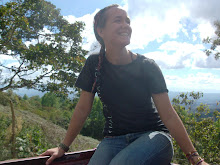
Sunday, March 20, 2011

beauty.

It’s been two months since I’ve arrived!

The past two weeks have been absolutely wonderful. Two weeks ago Kate was visiting and just this past week, Stonehill’s HOPE group spent their spring break here in Guiamaca. Having both Kate and then the HOPE trip here allowed me to step into their shoes and see everything with a fresh perspective. The passion, love, and generosity from the HOPE trip were contagious. I have noticed that I’m more open to others and have been appreciating the little things a lot more. Thank you. (They also brought enough chocolate to fill our freezer, for which we are very grateful!)

Along with the HOPE trip, Father Creegan (the President of the College) visited to check in on the program. Since this is the first year of the Extension Program in Honduras, he wanted to make sure that everything was going smoothly. Stonehill is the only College in the Fall River Diocese, along with the mission. So Stonehill has been involved with the mission for quite a few years now, since the start of Centro Marie Poussepin. It was one of the first international HOPE sites, and now is the home of three long-term volunteers. It’s clear how important the success of the program is to the Sisters, to Father Creegan, and to Kris (our program director).

Micha (Stonehill ’08) spent a year in Guaimaca after his graduation and was here to visit for the week. He it has been really insightful to spend time with him and reflect with him about service and our experiences here. Today he’s going to introduce us to a few families that he was close with, passing the torch. He has challenged me throughout the week to delve deeper to find what my spirituality means to me, how to make service and solidarity more permanent in my life, and what motivates me to serve others. He told me of the time that he spent in India at Mother Teresa’s mission and how it opened him even further to suffering and humanity. It reminded me that I don’t have to follow any “track,” instead I should let love be my guide.

Two nights ago we went to our second wedding mass. It is beautiful to see two young people come together with so much support from the community and their families. The ceremony took place in an aldea called San Marcos. It was held in a small but quaint chapel on the top of a hill, surrounded by mountains. There were so many people there that it was literally overflowing. I bounced between the windows and doorways to try and get a better view. In the middle of mass the sun began to set. It was so beautiful, it felt surreal.

This morning before mass ended a newborn was presented to the parish. It was reminiscent of Lion King when Father Craig held up the baby and everyone applauded to welcome him into the community. It’s moments like this and traveling to the aldea that make me fall in love with Guaimaca.

PS Happy Birthday, Pops! :)

Tuesday, March 8, 2011

Cauresma

I’m going to apologize in advance for the incoherent blog post that you’re about to read. It seems every day I learn more Spanish, I lose more English… I’m pulling that excuse today.

Every Tuesday, Wednesday and Thursday the students walk a few blocks to the church at the center of town after dinner. Tuesday is mass, Wednesday is acción juvenil (youth group) and Thursday is holy hour and confession. Tonight was the first night of youth group, to kick off the start of Cauresma (Lent) tomorrow. I wasn’t sure what to expect, so I was excited to see what was in store. The Bachillerato students were welcomed into the church by calm music and dim lighting. The pews were filled with young faces and high energy, a nice change from the other days of the week.

Father Craig is from MA and has been with the parish for the past seven years. From what I’ve noticed, he is a great asset to the community. He is very involved with and respected by the people. (He also cooks some rockin meals: pizza, green beans, irreplaceable dinner rolls, and cheesecake!)

So anyway, Father started off the night and introduced the reading. Several young people emerged from out back, dressed in costume and ready to act out the reading. Sometimes it’s hard to understand the reading in Spanish, so I was grateful to see that there was some theater involved.

The reading was from Matthew, how we are to learn from the hypocrites (Don’t pray out in public because then you have gotten your reward. Rather, pray in the privacy of your own room and you will be rewarded from God). I enjoyed reflecting on this reading because it’s important for me to remember that we must be honest with ourselves and do the right thing simply because it’s the right thing to do. It seems like a simple lesson, something that I learned when I was a kid, but embracing it fully can be a challenge.

After the reading, Father gave a bit of a homily. He pointed out how easily we can pick out the faults of others without considering our own faults first. He asked that we reflect on ways to direct that criticism to our own lives instead of that of others.  

We then were invited to go forward and pick a branch of a palm tree that parishioners had collected. It represented the things that we were to leave behind as we enter Lent. After a bit of silence we exited outside into the courtyard to burn the palms. We were each asked to place our palm in a metal basin to be used for tomorrow’s ashes.

The ambiance and sentiment of the time spent outside burning the ashes, clapping and signing (including the typical Our Father sung to Simon and Garfunkel's Sound of Silence), praying, and reflecting was quite refreshing. It felt like a cleansing of sorts, seeing the palms (representing our faults) burning and recognizing the commitment that we were making to further develop our personal spirituality. Just being outside with the cool breeze, under the clear sky, gathered around the fire with the students and youth from the parish was enough to make me quite content.

It was a neat change to have palms from people’s back yards and be involved in the creation of the ashes. The night was very ceremonial and meaningful, and a part of Cauresma that I’ve never experienced before.
To top it all off, we celebrated Fat Tuesday with cake and juice- Honduran style. No cake is complete without marshmallow/fluff/questionable frosting and pineapple filling. Delish.

I’m looking forward to seeing what the rest of Lent looks like- especially Semana Santa!

PS Kate is here safe and sound. It’s been a joy to have her visiting and helping out with everything. She’s been learning a lot of Spanish and the girls are already giving her cards and poems. It’s been fun to put myself in her shoes and see things as if they were new again.  

Wednesday, March 2, 2011

fotos

Proud to share some pics...finally! 


Matt and I with the Segundo Bachiellerato class (seniors) 


From left to right: Tori, me, Chris, Digna (wonderful chef), Hermana Teresa (in charge of the academic component of the mission), Matt, Bishop of Fall River diocese (vising for a few days), Jaime (tutor for Tercero Ciclo, the 9th graders), Andrea (tutor for Primero Ciclo, the 7th graders), and Sonia (tutor for the 8th graders). 

Sunday, February 27, 2011

More reading

Another book recommendation for those of you looking to learn a bit more about Honduran culture:


I’ve only read a bit of it so far, but it’s quite informative and very interesting. It’s divided into three chapters: Violence, Alcohol, and Maquiladoras (sweat shops).

(Thanks Kris, for sending us down with this book!)

Tuesday, February 22, 2011

"Can we borrow your dog?"

Today we came home from work just like usual, put the bikes on the side of the house and I grabbed Ranger’s bowl to feed him dinner. Two boys came to the fence and asked to speak with us for a second. I was prepared with the usual, “No, we can’t play because we have work to do. This weekend we’ll have more time to play.”

I almost wish that they were asking us to play like usual. Instead they were wondering if they could borrow our dog. I wasn’t sure if I simply misunderstood, but after clarification, I realized that they were explaining that their female dog was in heat. They wanted puppies, and for our dog to father them.

What?!

So instead of sending the two kids back, I wanted to clarify with the grandmother who sent them over. She explained to us (multiple times and with some wonderful new vocab) that they could bring their dog to our house or we could bring our dog there. They just wanted to borrow him for a little bit, she said.
Thankfully Matt came with me because I didn’t know how to say no. He explained that it was the Sister’s dog and that we should check with them before we lend him to anyone. So even after giving a few more excuses, they insisted that we see the dog. She made sure that we realized that they would be a good match for each other and that we would talk tomorrow.

I’m interested to see what the sisters have to say about all this! Who knows if this is culturally acceptable or if it’s just a crazy abuela aching for some pups..

Saturday, February 19, 2011

Challenges

Every Friday the students leave right after lunch, so the four of us have dedicated those afternoons to reflecting with the sisters. This is only our second time spending a few hours with them talking, but it has already been immensely beneficial. The weeks are busy, so I’m thankful to have this time set aside to bring any concerns or thoughts to the table about how things are going.

We had a really great talk with Sister Teresa yesterday. We sat around for a couple hours talking about cultural differences within the educational system.

Over the past three weeks of teaching, the four of us tutors have recognized a great disparity between the students’ ability to know and understand the material. This ranges from the chiquitas (little ones) to the eldest. All of the classes have great difficulty taking the information that they receive and apply it. For example, if we’re doing grammar exercises then they won’t think about what a noun is; instead they’ll refer to the previous example to copy it. If the noun comes first, they’ll assume that the next example also begins with a noun.

The students also lack investigative curiosity, something that’s highly valued within the US educational system. In class the students rarely ask questions or challenge an opinion. At first I was willing to blame my accent/slow Spanish and my strange new face. But after three weeks, it’s hard to believe that their apprehensions are only temporary.

It’s incredibly frustrating to have a lecture, do activities, ask questions, and still not have any feedback or sign of understanding. Over time I hope to be able to find ways to better manage the class and get them more involved, but how does someone instill critical thinking skills? (Especially considering the ten years they spent in schools where memorizing is the only necessary skill.) I don’t even know where to begin.

This cultural difference is so strongly integrated into how the country functions, not just concerning education. When we first started classes we all asked our students what they wanted to do after they graduated. Many wanted to be teachers or agriculturalists and others said they wanted to be engineers, journalists, psychologists, or doctors. I’m inspired by their aspirations, but disappointed by their attitudes towards actually achieving these dreams. It’s as though they’ve accepted their lives as is and don’t look for other possibilities. There’s a disconnect between the education that they’re receiving and their everyday life. For me it is strange to see the youth of low economic status who don’t take advantage of the opportunity to change the course of their lives. Sure, some may become leaders of their communities, but I get a feeling that most would be okay with going back to the aldeas, having children, and just living their lives. In no way am I putting down this choice to support a family and be content with little. But I can’t help but wonder why they aren’t challenging the norms of society. Oppression and acceptance has been infiltrated into all levels of the culture.
Even when it comes to violence or death, there’s such an apathetic attitude. Every Monday I ask the students how their weekends were. This past week the younger girls responded with “bad”. They explained that someone died in their aldeas. They said it so nonchalantly, as if it were part of everyday life…most likely because it is.

So this is the challenge that we are faced with: Of course, it is to inspire our students to make social change with the education that they are receiving. But more importantly, it is to understand how poverty, oppression, and violence have become a normalcy, how we can find the balance between what we’re used to (growing up in a country where everyone has rights that they are entitled to and fought for) and a new culture and attitude.
I feel very overwhelmed, but confident that we will challenge ourselves and the students so that they can start to consider their dreams as more than just dreams. 

Tuesday, February 15, 2011

Feliz dia de amor y amistad!

(Yesterday was el dia de amor y amistad: the day for love and friendship!)
So much has happened in the past month, and I certainly haven’t been keeping up to date..
Teaching has been keeping me busy, but I’m really enjoying what I’m doing. (I’m mostly teaching Spanish and English for Primero Ciclo: 7th, Segundo Ciclo: 8th, Primero Bachillerato: 10th, and Segundo Bachillerato: 11th).

Before the students came we were told that we would have to start from scratch with the younger students. I didn’t believe it until I saw their work. Not using capital letters in the right places, never using periods, and misspelling a lot of basic words. We have a lot of work ahead of us, but so many are eager to learn that I’m not too worried.

With the older students I’m having them practice writing (and not just summarizing but expressing their opinions effectively). It sounds like it could be pretty complex, but I’m hoping that they’ll grasp the basic ideas to form a basis.

One of the biggest challenges has been getting the students to think critically and apply what they’ve learned instead of relying on rote memorization. Fostering those skills will take time, so it’s been a frustrating process without any immediate results. (On top of this, the classes are pretty shy and they revert to giggles when someone is called on.) Differences in the educational approach are mostly cultural and finding the balance between the two cultures has been tricky. (It’s easier to rely on what I’m used to…) Hopefully ways to intertwine the two approaches will become clearer as we continue.

I’ve recently become the unofficial librarian. Our library certainly isn’t comparable to a high school library in the States, but it serves its purpose. All of the books are locked away behind glass doors so the students have to ask permission to borrow a book and then sign it out. There are mostly reference books for the teachers, but I’ve enjoyed directing the students through the books that we have for them. It’s a nice way to get to know the girls and encourage them to read age-appropriate books. The majority like to read but just don’t have a whole lot of practice. (A few days after I was given this new responsibility I lost the only set of keys (!) but luckily they were found later the next day. Phew!)

We’ve had some really wonderful times here already: Last weekend we accompanied the priest to an aldea mass in the country -what a beautiful service! We’ve had our share of dinner guests and luckily have been invited over to dinner with our neighbors. The cook at the center came over one Sunday with her son to exchange recipes and cook for a bit. We cheered for our neighbor at one of his football games. Ate fried tortillas and guacamole while we watched the Super Bowl (in Spanish). And unfortunately got some amoebas at Valley of the Angels but quickly recovered.

In the future I hope to do a better job of keeping everyone updated : ) Good night!